Columbia space shuttle disaster
The Wisdom of CrowdsThe Columbia space shuttle disaster was the February 1, 2003 loss of the shuttle Columbia during reentry, after foam debris struck its left wing during launch. The book’s account makes the disaster a test of collective decision-making: engineers had identified uncertainty and sought better evidence, but the Mission Management Team (MMT) treated the threat as settled before it had been properly investigated. The consequential failure was not simply a lack of information; it was the team’s failure to make room for doubt, dissent, and the judgments of its members.
The strike and the missing evidence
On January 16, 2003, Columbia began mission STS-107, its twenty-eighth flight. During ascent, a large piece of foam broke from the left bipod area of the shuttle’s external fuel tank and struck the left wing. Launch-tracking cameras did not provide a clear picture of the impact, leaving engineers unable to determine how much damage it had caused. The shuttle’s MMT held its second teleconference on January 21, while the Debris Assessment Team (DAT)—engineers from NASA, Boeing, and Lockheed Martin—had spent much of the previous five days examining the possible consequences of a debris strike.
The DAT had to work with limited information. It estimated the foam’s size and impact speed, then used an algorithm called Crater to predict how deeply a piece of debris would penetrate the thermal-protection tiles. The team had reached no conclusion, but it had made clear that the damage warranted concern. A request for on-orbit images of Columbia had been made by January 21, but it had not been approved. Those images could have helped establish where the foam hit and what the wing looked like; without them, the engineers’ assessment remained constrained by an uncertain impact location and an imperfect analytical tool.
In the January 21 teleconference, the foam strike surfaced only about two-thirds of the way through a meeting that had already covered matters including a jammed camera, shuttle experiments, and a leaky water separator. When MMT leader Linda Ham asked for an update, Don McCormack described the investigation and possible repair work, and noted that a similar strike on an earlier shuttle flight had caused fairly significant damage. Ham nevertheless dismissed the incident as not a factor during the flight because, in her view, there was little the team could do about it. The MMT had only just received details of the strike; it had not heard the DAT’s full assessment or discussed what previous debris impacts might imply.
Uncertainty turned into reassurance
Ham’s response did more than express her own judgment: it established the frame through which the rest of the team encountered the problem. The book argues that she had already decided the strike was inconsequential and effectively decided that for the other people in the meeting as well. Rather than begin with the evidence and work toward a conclusion, the group proceeded as if the central question—whether foam could seriously damage the shuttle—had already been answered. A technical adviser’s conviction that foam could not cause serious harm reinforced that assumption, even though evidence pointed toward the need for further inquiry.
That prior conclusion shaped what the team did next. MMT members rejected requests for on-orbit images, in part on the stated ground that their resolution would not show the small impact area. Yet none of the managers making that judgment had the required security clearance to know how good the images would be, and none asked the Department of Defense, which could have taken them, about their quality. The team thus made a critical decision about available evidence while lacking the knowledge needed to evaluate it. Its confidence exceeded its information.
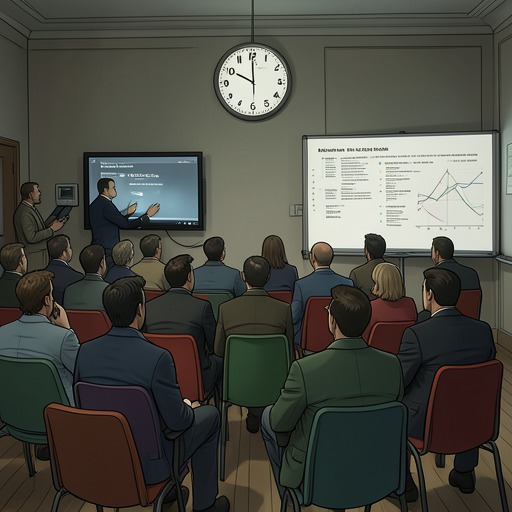
The DAT’s January 24 briefing made the uncertainty explicit. In a crowded briefing room, the engineers presented five possible scenarios. Their overall conclusion was that the shuttle was likely safe, but they stressed that the analysis was profoundly limited: without images, they did not know exactly where the foam had struck, and Crater had been designed for debris hundreds of times smaller than the piece that hit Columbia. Its results therefore could not be treated as definitive. The qualified conclusion depended on assumptions and incomplete tools; it was not a finding that serious damage had been ruled out.
An hour later, McCormack summarized the briefing to the MMT. He reported the potential for significant damage, the lack of an indicated burn-through in the thermal analysis, and substantial uncertainty about the debris’s size, impact location, and angle. Ham repeatedly translated these caveats into formulations that pointed toward safety: no burn-through, no catastrophic damage; no safety-of-flight issue; no change needed for the mission. When another participant said he had not heard McCormack, Ham summarized the exchange again and asked whether there were questions. The discussion ended without anyone requesting the DAT study or probing the uncertainties McCormack had described.
The meeting’s silence was not evidence that the analysis was secure. The Columbia Accident Investigation Board noted that McCormack’s summary omitted the DAT’s supporting analysis and any account of disagreement within the team. No MMT member asked a question or expressed interest in examining the study. Ham’s brisk summaries narrowed the space for debate, while the meeting’s question-and-answer format left little structure for soliciting views from other participants. The team neither surfaced minority opinions nor tested its assumptions collectively.
A disaster with possible alternatives
The book cautions against treating the MMT as the sole explanation for the loss. NASA had deep institutional and cultural problems, many resembling those present when Challenger exploded in 1986, and a focus on one team can obscure that broader dysfunction. At the same time, the available investigation supported a more specific conclusion: the MMT had opportunities to make different choices that could have improved the crew’s chances of survival. On multiple occasions team members were urged to gather information needed for a reasonable safety assessment, and they were warned that the foam might have caused burn-through—heat penetrating the protective tiles and reaching the shuttle’s fuselage. The team’s leaders themselves raised the possibility that the damage might be severe, yet the group never reached a sound decision about what to do.
The assumption that finding damage would make no difference also discouraged the team from looking for it. During the Columbia Accident Investigation Board inquiry, NASA engineers developed two strategies that might have brought the crew back safely, although the shuttle itself was doomed from the moment of impact. The MMT had no reason to know those strategies in advance. Its failure was to decide, without first examining the evidence, that no solution would be possible if a problem existed. An unnamed NASA source’s personal notes recorded Ham’s reason for canceling the image request: it was no longer being pursued because even if the team saw something, it could do nothing about it. That reasoning joined two untested assumptions—there was no need to determine the damage, and no response could help—into a rationale for not obtaining the evidence that could have informed either judgment.
Why the group failed
The account places the Columbia case within the wider difficulties of small-group decision-making. Unlike a market, where participants need not experience themselves as members of one deliberating group, the MMT was a team whose members interacted directly and consciously worked toward a shared decision. That form can pool expertise, but it can also make consensus more important than disagreement. When a group identifies too closely with its own position, dissent can feel disruptive; even without an extreme form of groupthink, members may prefer an appearance of certainty to an honest recognition of doubt.
The MMT’s process combined premature closure with confirmation bias: decision-makers unconsciously seek information that supports their initial intuitions. Once the team regarded serious damage as unlikely, it discounted contrary evidence and treated further investigation as unnecessary. Its members also acted on an unwarranted sense of what they knew, particularly when they asserted that images would be inadequate without having the clearance or information required to assess image resolution. The analysis was not merely incomplete; the organization’s confidence prevented it from correcting that incompleteness.
The team’s procedures compounded the problem. Most discussion followed the pattern of Ham asking a question and another person answering, but there was no corresponding effort to invite each member to comment on specific issues. In the book’s account, this made the conversations at once too structured and not structured enough: tightly directed by the leader, yet lacking an agenda for bringing the group’s full supply of information and analysis into the decision. Research on small groups points to the value of clear agendas and leaders who actively make room for everyone to speak. The MMT’s meeting did not provide that kind of structured deliberation.
Hierarchy further weakened the connection between expertise and decision. NASA might be imagined as meritocratic and bottom-up, but the book characterizes it as deeply hierarchical. The DAT engineers’ concerns—especially their insistence that they needed wing images to make an informed assessment—never received a serious hearing from the MMT. Technical specialists could investigate the problem, yet their uncertainty and requests did not determine what evidence the leadership was willing to obtain. The organization had distributed expertise without creating an effective process for letting that expertise alter the group’s conclusion.
Consequences and significance
The shuttle was lost on February 1 as it reentered Earth’s atmosphere. In the book’s interpretation, the failure of the January discussions lies not only in what the team concluded, but in how it arrived there: incomplete evidence was converted into reassurance, uncertainty was compressed into confident shorthand, and no member’s judgment was formally gathered into a collective decision. The MMT never voted on anything. Members reported on different aspects of the mission, but their individual opinions were never aggregated. The book treats this absence as a serious error even apart from the disaster’s outcome, because a team that serves only as an advisory structure may surrender the collective judgment that makes teamwork useful.
The episode also complicates any simple prescription to abolish small groups. Other research cited in the book found that groups can make quick, accurate decisions and sometimes outperform even their best individual member. A study by Alan S. Blinder and John Morgan, designed to examine group decision-making under conditions loosely modeled on the Federal Reserve’s task, found that a group identified a change in the balance of red and blue balls faster and more accurately than individuals: it chose the correct direction 89 percent of the time, compared with 84 percent for individuals. The contrast does not mean that groups are inherently wise or inherently foolish. It makes the quality of the process decisive: deliberation can help when judgments are exposed and combined, but a group that suppresses questions and never aggregates its members’ views can magnify error instead.
Columbia therefore serves as a case study in the difference between decentralizing expertise and coordinating it. The DAT possessed specialized knowledge, but its findings reached the MMT in a form that did not compel the team to confront the limits of its analysis. The group had information and people capable of interpreting it; what it lacked was a reliable way to make those contributions collectively consequential. In that sense, the disaster’s organizational lesson is not simply to centralize authority or defer to a single expert. It is to preserve room for independent judgment, seek evidence before settling on a verdict, and give a group a genuine mechanism for weighing what its members know.